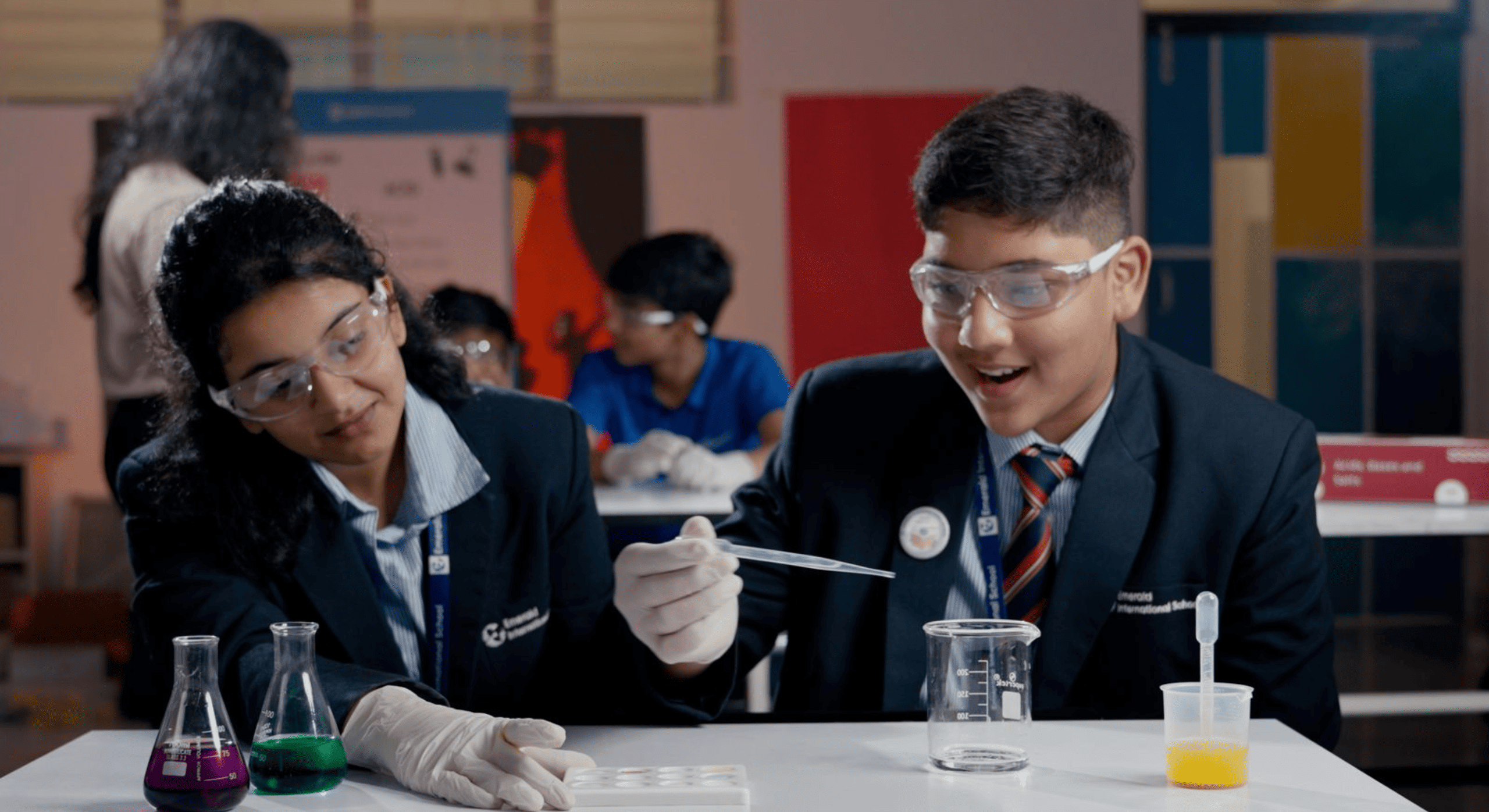
“I understood it only when I actually did it.”
Every teacher has heard some version of this.
A student struggles with a concept. Definitions are explained, notes are written, questions are solved – and yet, something still doesn’t click.
Then the teacher introduces an activity. Suddenly, the student gets it.
They aren’t just remembering the answer anymore. They understand it.
That moment is at the heart of experiential learning.
So, what is experiential learning?
Experiential learning is an approach where students learn by doing, exploring, investigating and reflecting on real experiences rather than only listening to explanations or memorising information.
In simple terms: Instead of only telling students what happens, allow them to discover why it happens.
A science experiment, a real-world problem, a project, a simulation, an investigation or even a simple classroom activity can become an experiential learning opportunity.
The important part is what happens after the activity: students think, reflect, connect and apply what they have discovered.
Why does experiential learning matter?
Think about how children learn outside school.
A child doesn’t learn to ride a bicycle by memorising how balance works.
They try.
They wobble.
They adjust.
They try again.
And eventually, they learn.
Classroom learning can work in much the same way. When students actively participate, they get opportunities to:
- Understand concepts instead of simply memorising them
- Ask questions and investigate answers
- Connect classroom learning to everyday life
- Develop critical-thinking and problem-solving skills
- Learn from mistakes
- Collaborate with others
- Apply what they know
Most importantly, students begin to see learning as something they do, rather than something that simply happens to them.
What does experiential learning look like in a classroom?
Imagine a teacher introducing evaporation. Instead of beginning with a definition, the teacher asks:
“Why do wet clothes dry faster on a hot, windy day?”
Students make predictions. They discuss their ideas. They compare what happens to water under different conditions. They observe. They question. Only then does the teacher introduce the scientific explanation.
The definition hasn’t disappeared. It now has something to connect to.
The students have experienced the concept first.
And experiential learning isn’t limited to science.
In mathematics, students can explore measurement by measuring objects around them.
In social science, they can investigate a local issue.
In language, they can interview people, create stories or role-play different perspectives.
In computer science, they can build, test and improve something.
The subject changes.
The principle remains the same: students actively engage with what they are learning.
Is experiential learning the same as activity-based learning?
They’re closely related, but not the same. Activity-based learning focuses on learning through activities.
Experiential learning goes further by connecting the activity to reflection, conceptual understanding and application.
For example, students could build a paper bridge.
Experiential learning happens when they:
- Build and test it.
- Observe what happens.
- Discuss why it worked or failed.
- Connect their observations to concepts such as force and load.
- Modify the design and test it again.
Doing + reflecting + understanding + applying = deeper learning.
Does experiential learning require expensive equipment?
Not necessarily. Some of the most effective learning experiences can begin with everyday materials:
Paper. Balloons. Magnets. Rubber bands. Water. Ice. Salt. Leaves. Cups. Newspapers.
The value of an activity doesn’t come from how expensive the equipment is.
It comes from the question students are trying to answer and what they do with what they discover.
However, making experiential learning a consistent part of everyday teaching can be challenging. Teachers need curriculum alignment, ready-to-use resources, appropriate activities and time-efficient ways to assess learning.
That’s where the right support can make a difference.
How can teachers bring experiential learning into everyday classrooms?
It doesn’t require changing every lesson overnight.
Start small.
Start with a question
Instead of immediately explaining a concept, ask: “Why does this happen?”
– Let students predict
Give them space to make – and test – their own ideas.
– Give them something to explore
This could be an experiment, investigation, model, simulation or real-world problem.
– Ask them to reflect
What happened? Why do you think it happened? Where do you see this in real life?
– Connect it back to the concept
This is where the textbook, definition or theory becomes meaningful.
– Let them apply it
Can students use what they learned in a new situation?
That’s when an activity becomes a learning experience.
How can Xperimentor help?
For many schools, the challenge isn’t understanding why experiential learning matters. It’s implementing it consistently.
Teachers already have curriculum targets, lesson plans, assessments, classroom management and limited preparation time.
Xperimentor helps schools bring experiential learning into everyday classrooms through curriculum-aligned hands-on activities, inquiry-based digital learning, teacher resources, competency-based assessments and AI-powered insights.
The goal isn’t to replace the teacher.
It’s to give teachers better tools to create opportunities where students can question, explore, experiment, understand and
apply.
So, does experiential learning really work?
Perhaps the better question is:
What happens when students experience an idea instead of simply hearing about it?
They ask more questions.
They test their ideas.
They make mistakes.
They discuss what they observe.
They connect concepts to the world around them.
And sometimes, they discover something the teacher didn’t expect either.
That’s the beauty of experiential learning.
Learning doesn’t stop when the teacher finishes explaining.
Sometimes, that’s when it finally begins.