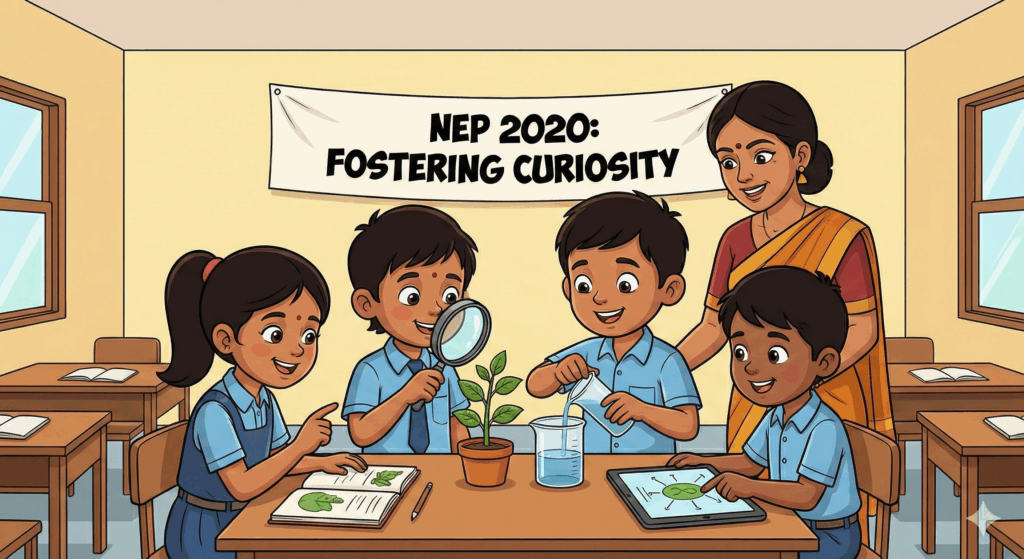
40000 – that’s the whopping number of questions a child is believed to ask between the ages of 2 and 5, with a daily average hovering around 400 in the 3rd year alone! This number drastically plummets in the coming years.
A decade ago, a kindergarten proudly advertised, ‘Your 3 year old asks 357-odd questions everyday and we will answer them in as many unique ways’. A few years later, another school had an ad, ‘Are you preparing your child for the rat-race? What if he is a lion?’
The change in mindset was more than apparent. The stark difference reflected a deeper message – from celebrating curiosity to grooming children for competition.
The undue focus on marks and academic achievement has stripped childhood and learning of essential traits like wonderment, exploration and the freedom to question and experiment.
Is the collateral damage, a vibrant curiosity – nipped in the bud?
Acknowledging the growing negative implications of contemporary education, the Government of India in the National Education Policy 2020 (NEP 2020) has called for a fundamental shift, away from traditional methods to a holistic one that fosters critical thinking, problem-solving making a child future-ready. The framework recognises that nurturing curiosity is, at this time, not optional, but rather essential.
In this series, let us explore why curiosity is vital, how the system is silencing it, and what the way forward could be.
The American Psychological Association defines curiosity as the impulse or desire to investigate, observe, or gather information, particularly when the material is novel or interesting. Curiosity, in that sense, is the fuel that drives exploration and learning.
George Loewenstein, a prominent psychologist, proposed the Information Gap Theory in his research on curiosity. He explains that a gap between what we know and what we want to know creates a psychological tension that one is naturally bound to relieve by filling in the gap. This curiosity-driven quest for information satisfies the brain’s innate need for resolution and understanding, following which the brain releases a hormone, dopamine – associated with motivation and reward.
As we all know, what comes from within lasts, unlike something that is forced upon. In this light, NEP 2020 assertively calls for curiosity-driven learning – one that enables problem-solving, adaptability and such skills required for 21st century readiness.
Research shows that curiosity acts as a catalyst for deeper learning, boosting both memory and motivation. A well-known study by Gruber, Gelman, & Ranganath (2014) demonstrated that curiosity activates the hippocampus – a region of the brain responsible for memory. Like a cherry on the cake, the study also noted that participants remembered information better – not just about what they were curious, but also about other irrelevant information presented around the same time – a phenomenon known as the spillover effect.
Intrinsic motivation – an internal drive to explore, ask questions and seek answers – aligns with the principles of educational psychology – and leads to longer-lasting and deeper learning.
So, why then is curiosity being silenced quietly?
It is now the norm that the singular emphasis is on exams, correct answers, and high scores in a time-bound curriculum. Appreciation has long been reserved for the right answers, but very rarely for asking the right questions.
In today’s classrooms, asking questions comes with the risk of being ridiculed, dismissed or rebuked – subtly but strongly dissuading children from voicing their curiosity. Whether due to time-constraints or the fear of making mistakes – felt by both students and teachers – the ultimate casualty has been learning.
Despite progressive policy pushes from the NEP 2020, there still persists a significant gap in implementing inquiry-based and experiential learning activities.