When Science Feels More Stressful Than Exciting
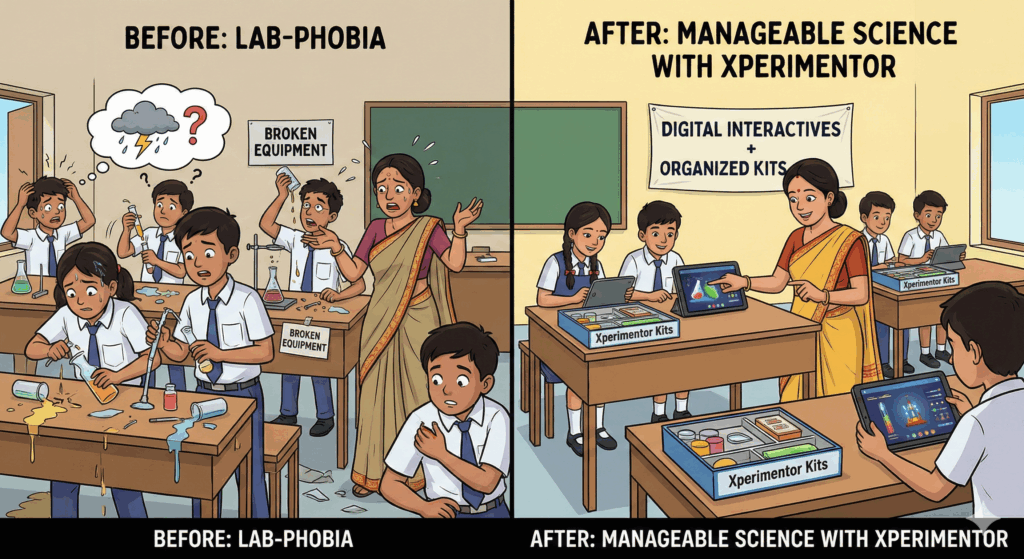
For many teachers and students, the word lab doesn’t spark curiosity-it sparks anxiety. Broken apparatus, missing materials, time-consuming setup, safety concerns, syllabus pressure, and the inevitable post-lab mess often turn hands-on science into a stressful affair. This fear, commonly called “lab-phobia,” quietly pushes classrooms back to chalk-and-talk methods, even when everyone knows that science is best learned by doing.
So how do we bring back the joy of experimentation without the chaos? The answer lies in making hands-on science manageable-by rethinking how labs are designed, delivered, and experienced. With digital interactives and well-organized science kits, practical learning can finally become structured, stress-free, and deeply engaging.
Understanding Lab-Phobia in Schools
Lab-phobia isn’t about a lack of interest in experiments. It’s about practical challenges that overwhelm educators and institutions:
Limited lab periods and tight timetables
Inadequate or shared laboratory infrastructure
Fear of spills, breakage, and safety issues
Difficulty managing large classrooms during experiments
Pressure to complete the syllabus on time
As a result, hands-on learning often gets postponed, rushed, or skipped altogether-leaving students with theoretical knowledge but little scientific confidence.
Why Traditional Science Labs Feel Unmanageable
Traditional labs were designed for ideal conditions-dedicated spaces, ample time, and small groups. Today’s classrooms rarely fit that mold.
Teachers often spend more time preparing, supervising, and cleaning up than actually facilitating learning. When experiments feel like logistical hurdles rather than learning opportunities, it’s natural for schools to avoid them.
This is where the need for making hands-on science manageable becomes critical-not by removing experiments, but by redesigning how they happen.
The Power of Digital Interactives in Science Learning
Digital interactives are transforming how students experience practical science.
Instead of jumping straight into a physical experiment, students can:
Visualize concepts through simulations
Predict outcomes before performing experiments
Repeat experiments virtually without fear of mistakes
Connect real-world observations with scientific theory
These interactives reduce uncertainty for both teachers and students. When learners know what they’re doing and why they’re doing it, physical experiments become smoother, safer, and more meaningful.
Digital tools don’t replace hands-on learning-they prepare and enhance it, making practical sessions more focused and effective.
Organized Kits: From Lab Chaos to Classroom Control
One of the biggest stress points in traditional labs is material management. Missing components, incorrect quantities, or last-minute substitutions can derail an entire session.
Organized experiment kits solve this by:
Providing pre-measured, curriculum-aligned materials
Ensuring every group has exactly what they need
Reducing setup and cleanup time
Allowing experiments to happen inside regular classrooms
With kits, experiments are no longer limited to a lab room. Any classroom can become a science space-controlled, safe, and efficient.
How Digital + Kits Make Hands-on Science Truly Manageable
The real magic happens when digital interactives and organized kits work together.
Digital modules introduce concepts and guide inquiry
Step-by-step experiment instructions reduce confusion
Kits ensure uniformity and ease of execution
Teachers shift from “managing materials” to “facilitating thinking”
This blended approach removes fear from experimentation. Students feel confident, teachers feel in control, and learning becomes intentional rather than chaotic.
This is the essence of making hands-on science manageable-structure without rigidity, exploration without mess.
Xperimentor: Redefining Hands-on Science for Today’s Classrooms
At Xperimentor, we believe that every child deserves to experience science, not just memorize it.
Our approach is built on:
Curriculum-aligned digital interactives that build conceptual clarity
Well-designed, classroom-friendly kits that simplify experiments
A focus on inquiry, observation, and reflection-not rote procedures
By integrating technology with tactile learning, Xperimentor helps schools overcome lab-phobia and confidently adopt experiential science. Teachers no longer have to choose between syllabus completion and meaningful learning-they can achieve both.
It’s Time to Bring Experiments Back-Without the Fear
Hands-on science should feel exciting, not exhausting. By embracing digital interactives and organized kits, schools can finally overcome lab-phobia and make experimentation a natural part of everyday learning.