What History’s Greatest Minds Can Teach Us About the Usage of Today’s Digital Tools and Simulations
A Genius, a Stylus, and a Wi-Fi Connection
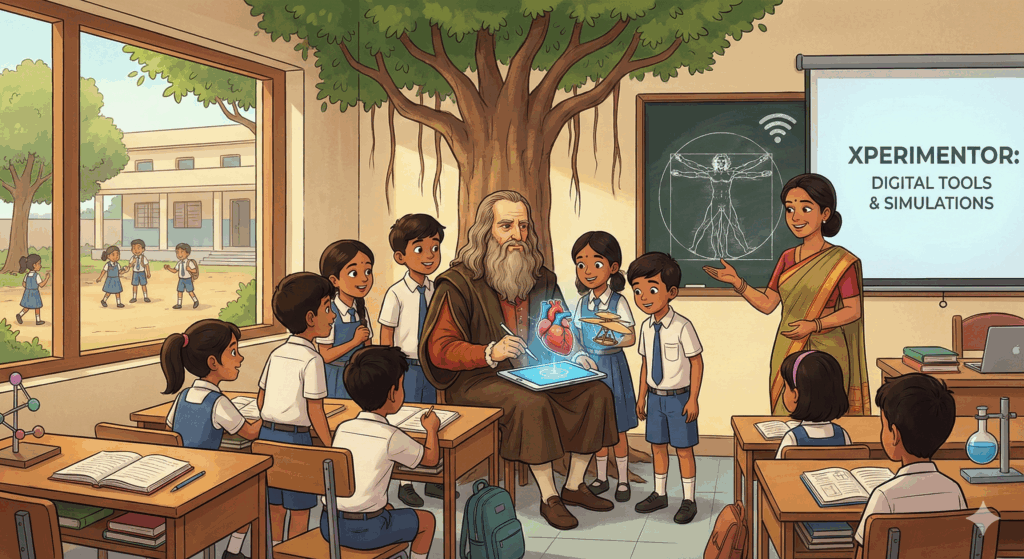
Imagine Leonardo da Vinci sitting under a tree, not with parchment and ink, but with an iPad and Apple Pencil. No smudged notebooks. No half-finished sketches lost to time. Just infinite canvases, simulations, and tools waiting to be explored.
Leonardo wasn’t just an artist. He was an engineer, anatomist, inventor, and relentless experimenter. His brilliance came from curiosity in motion-observing, testing, failing, refining.
Now here’s the fun question:
What if Leonardo had access to the usage of today’s digital tools and simulations?
More importantly-what does that mean for how we learn today?
Leonardo da Vinci: The Original Xperimentor
Long before STEM became a buzzword, Leonardo was already living it.
He dissected human bodies to understand anatomy
He sketched flying machines centuries before airplanes
He studied water flow, mechanics, optics, and geometry
He learned by doing, not memorizing
Leonardo didn’t wait for answers. He built them.
That’s exactly what makes him one of history’s greatest Xperimentors.
If Leonardo Had an iPad… Here’s What He’d Probably Do
Let’s speculate-because learning should be fun.
1. Anatomy in 3D, Not Just on Paper
Instead of painstaking dissections alone, Leonardo would explore 3D anatomy simulations, rotating organs, zooming into muscles, and comparing systems instantly.
Mistake made? Undo.
New hypothesis? Simulate again.
The usage of today’s digital tools and simulations would let him test ideas faster, safer, and deeper-without losing the joy of discovery.
2. Flying Machines, Now With Real-Time Physics
Those famous flying machine sketches?
Imagine Leonardo running them through aerodynamics simulations.
What if the wings were longer?
What if the material was lighter?
What if human power wasn’t enough?
Instead of years of trial and error, he’d iterate in minutes-learning from every failed simulation.
Failure wouldn’t be the end.
It would be data.
3. Art Meets Algorithms
Leonardo studied light, shadow, symmetry, and proportion obsessively.
With today’s digital tools, he’d probably:
Experiment with light simulations
Analyze proportions using grids and overlays
Blend art, math, and science seamlessly
Because for Leonardo, learning was never siloed-and neither is it with the right tools.
The Real Question: Why Don’t All Learners Get This Experience?
Leonardo learned by:
Asking questions
Testing ideas
Observing outcomes
Reflecting and improving
Yet today, many classrooms still rely heavily on:
This is where the usage of today’s digital tools and simulations becomes transformational-if they’re used the right way.
Tools don’t replace thinking.
They unlock it.
Learning the Leonardo Way
At Xperimentor, we believe every learner deserves the freedom to think, test, and explore-just like history’s greatest innovators.
Our platform is designed to:
Turn abstract concepts into hands-on digital experiences
Use simulations, quests, and experiments aligned with the curriculum
Encourage students to ask “What if?” instead of “Will this be in the exam?”
We don’t just show answers.
We help learners build them.
Because when students engage with the usage of today’s digital tools and simulations in the right way, learning stops being passive-and starts becoming personal.
What Leonardo Would Love About Xperimentor
If Leonardo logged into Xperimentor today, he’d probably say:
“Ah! I can test this idea instantly.”
“Let me try another approach.”
“Interesting… why did this fail?”
That’s not fantasy.
That’s experiential learning.
Xperimentor bridges the gap between curiosity and understanding, using modern tools to nurture timeless thinking skills.
The Future of Learning Is Experimental
Leonardo da Vinci didn’t become a genius because he memorized facts.
He became one because he experimented fearlessly.
Today, we finally have the tools to offer that same experience to every learner-not just the exceptionally curious.
The real challenge isn’t access to technology.
It’s how we use it.