The Classroom Question We Can’t Ignore
Artificial Intelligence is no longer a future concept-it’s already grading assignments, answering questions, and personalising content. As we look ahead to the next decade, a bigger question emerges:
Is your classroom ready for 2030?
While technology is evolving rapidly, the skills students truly need are deeply human-critical thinking, collaboration, creativity, and problem-solving. These are the soft skills that AI cannot replicate. And the most effective way to build them?
Hands-on learning.
In this blog, we explore why experiential, hands-on classrooms are essential to creating a Classroom Ready for 2030-and how platforms like Xperimentor are helping schools make this shift.
Why “Classroom Ready for 2030” Means More Than Smart Boards
When we talk about a Classroom Ready for 2030, it’s easy to imagine smart boards, tablets, and AI tools. But hardware alone doesn’t prepare students for the future.
A future-ready classroom focuses on:
The workplace of 2030 will demand learners who can analyse situations, work in teams, adapt to change, and ask the right questions-skills that cannot be automated.
The Skills AI Cannot Replace
AI can process information faster than humans, but it struggles with:
Critical Thinking
Students must learn how to question data, evaluate outcomes, and make informed decisions. Critical thinking develops when learners actively do, test, and reflect-not when they passively listen.
Collaboration
Real-world problems are rarely solved alone. Working in teams, managing conflicts, and valuing diverse perspectives are human skills best learned through group activities and shared challenges.
Creativity & Problem-Solving
AI follows patterns. Humans create new ones. Hands-on learning encourages experimentation, failure, iteration, and innovation-key traits for future success.
A Classroom Ready for 2030 must intentionally nurture these skills.
Why Hands-On Learning Works Best
Hands-on learning transforms students from passive receivers into active participants. Instead of asking, “What is the answer?”, students begin to ask, “Why does this happen?” and “How can we improve it?”
Here’s why it works:
Deeper understanding: Learning by doing strengthens conceptual clarity.
Higher engagement: Students are naturally curious when they interact with materials and real-life problems.
Skill integration: Cognitive, social, and emotional skills develop together.
Experiential learning mirrors the real world-making it the most powerful preparation for the future.
What a Classroom Ready for 2030 Looks Like
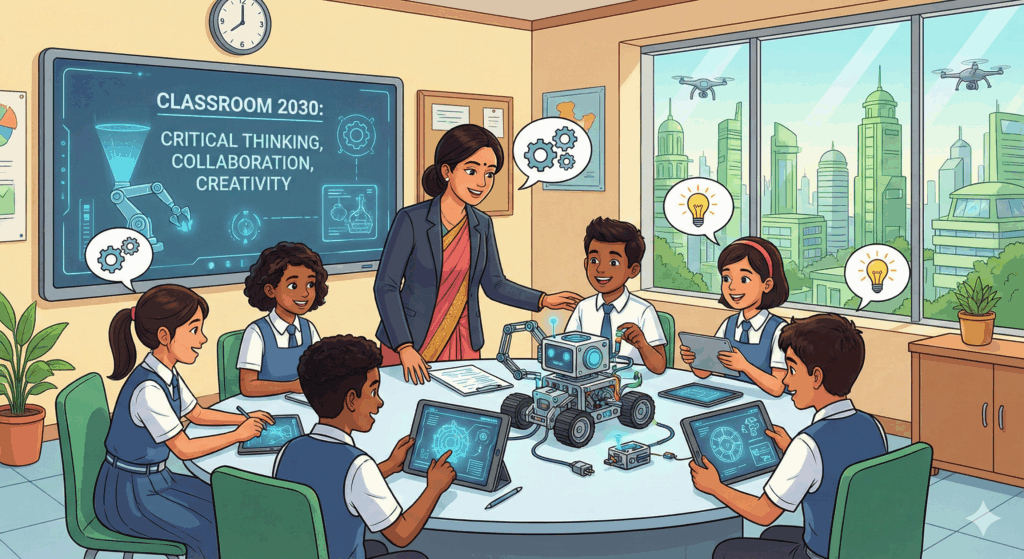
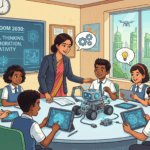
A future-ready classroom is not silent rows of students copying notes. Instead, you’ll see:
Students working in small groups
Teachers acting as facilitators, not just instructors
Real-world problems connected to curriculum concepts
Reflection, discussion, and peer learning
This shift requires the right tools, mindset, and support system.
How Xperimentor Helps Build a Classroom Ready for 2030
At Xperimentor, we believe learning comes alive when students experience concepts, not just read about them.
Xperimentor supports schools by:
Offering curriculum-aligned, hands-on activities
Encouraging inquiry, experimentation, and reflection
Empowering teachers with structured experiential frameworks
Helping students build critical thinking, collaboration, and problem-solving skills
By integrating experiential learning into everyday classrooms, Xperimentor helps schools move beyond traditional methods and create truly future-ready classrooms.
The Teacher’s Role in the 2030 Classroom
Teachers remain irreplaceable.
In a Classroom Ready for 2030, teachers:
Guide inquiry instead of delivering one-way lectures
Create safe spaces for failure and exploration
Observe, assess, and support skill development-not just marks
Xperimentor equips educators with tools and training to confidently make this transition.
The Future Belongs to Experiential Classrooms
Preparing students for 2030 is not about competing with AI-it’s about strengthening what makes us human.
Hands-on learning builds thinkers, collaborators, and innovators. It ensures your classroom isn’t just technologically updated, but future-ready in spirit and practice.